

Best Portable Solar Chargers for Remote Activities
Table of Contents
- Portable Solar Chargers for Remote Activities: What You Need to Know
- Quick Comparison Table
- Solar Panel Wattage Requirements for Electronics
- Best Solar Power Bank for Backpacking
- How to Choose a Portable Solar Charger
- Portable Solar Charger Efficiency Tips
- Real-World Performance: Weather and Conditions
- Best Use Cases: Camping, Hiking, and Emergency Preparedness
- Conclusion
- Frequently Asked Questions
Last Updated: September 20, 2026
Portable Solar Chargers for Remote Activities: What You Need to Know
Outdoor enthusiasts face a persistent problem: staying powered where traditional electricity doesn't exist. Portable solar chargers convert sunlight into usable energy for phones, tablets, and power banks. This guide covers selecting, using, and maximizing the efficiency of portable solar chargers for remote activities.
A portable solar charger keeps your devices alive without relying on generator fuel, vehicle batteries, or wall outlets. The real question is which charger fits your specific use case, budget, and power needs.
Quick Comparison Table
| Product | Power Output | Best For | Price | Key Feature |
|---|---|---|---|---|
| 60W Foldable Solar Panel | 30W-60W | Multi-device charging | $200.00 | Monocrystalline silicon, 23% efficiency |
| Portable Foldable Solar Charger Power Bank | Flexible output | Extended backcountry trips | $210.00 | Integrated power storage, off-grid capable |
| 30W Foldable Solar Panel | 30W | Hiking and camping | $107.00 | Dual USB+DC ports, IP67 waterproof |
| 20W Lightweight Foldable Panel | 20W | Solo backpackers | $161.00 | Ultra-lightweight (226g), IP65 rated |
| Budget Folding Solar Panel | 7.2W-9W | Emergency backup | $31.73 | Compact, compass carabiner included |
| 100W Solar Panel Folding Bag | 60W-100W | Base camp power | $288.00 | Multiple output ports, premium materials |
| Premium 2024 Solar Panel | Variable | Advanced users | $521.00 | Enhanced efficiency, professional-grade |
| Waterproof Foldable Charger | 25W-100W | Diverse use cases | $164.00 | IP65 waterproof, adjustable fold options |
| Solar Phone Charger (Red/Black) | Compact output | Casual outdoor use | $27.94 | Dual USB ports, micro-USB input option |
| 35L Solar Backpack | 30W integrated | Full-day hiking | $403.00 | Built-in panel, 35-liter capacity |
Solar Panel Wattage Requirements for Electronics
A 30W panel theoretically delivers 30 watts under ideal conditions, but actual output depends on sun angle, cloud cover, panel cleanliness, and temperature.
Most smartphones require 5W to 15W for charging. A 20W portable solar charger fully charges a phone in 2-3 hours under direct sunlight, but 5-8 hours on overcast days.
Tablets need 20W-30W for reasonable speeds. For simultaneous multi-device charging, aim for 30W-40W output.
Laptops require 45W-100W for active charging. Portable solar chargers (20W-60W) can only trickle-charge laptops; for reliable laptop power, use a high-wattage panel (60W+) with a large battery or a portable power station.
Best Solar Power Bank for Backpacking
The Portable Foldable Solar Charger Power Bank at $210.00 stands out for backpacking. This charger does not contain an internal battery and must be used with an external power storage device.

The Portable 20W Foldable Solar Panel USB Charger at $161.00 weighs 226 grams (8 ounces) when folded with 22% solar conversion efficiency, more usable power per gram than older designs.
For budget-conscious backpackers, the Budget Folding Solar Panel at $31.73 provides emergency backup charging. It won't power a tablet, but it can add 10% to 20% charge to a phone on a day-long hike. Pair it with a small 5,000mAh power bank and you have a complete lightweight charging system for under $50.
How to Choose a Portable Solar Charger
Selecting the right portable solar charger requires weighing five critical factors: wattage, weight, durability, charging speed, and real-world efficiency under variable conditions.
Weight and Portability
The 20W Lightweight Panel at 226 grams fits most backpack pockets and attaches via carabiners to charge a power bank while you walk.
The 60W Foldable Solar Panel at $200.00 weighs 1.5-2 pounds but delivers more power, better for base camp setups.

For car camping or vehicle-based trips, weight is nearly irrelevant. A heavier 100W panel sitting on your tent or vehicle roof charges multiple devices simultaneously without adding to your hiking load.
Durability and IP Ratings
IP65 protects against dust and water jets; IP67 allows partial immersion. These ratings matter in the field.
The 30W Foldable Solar Panel carries a high waterproof level with ETFE lamination, scratch-resistant, and maintains light absorption.

Lower-rated panels with IP54 or IP55 protection handle light rain and dust but shouldn't be submerged or exposed to heavy spray. If you're hiking in wet climates or near water, prioritize IP67 or IP65 minimum.
One critical caveat: the USB ports themselves are rarely waterproof even on highly-rated panels. Keep the connector dry and avoid plugging in devices during active rain. The port area is the failure point in most wet-weather scenarios.
Charging Speed and Device Compatibility
Modern phones support different charging protocols: standard USB (5V), Quick Charge 3.0, USB Power Delivery, and proprietary fast-charging standards.
The 30W Foldable Solar Panel includes dual USB ports (QC 3.0 and standard) plus a 12V DC port with intelligent voltage regulation for simultaneous multi-device charging.
The 20W Lightweight Panel provides 5V/1.5A output, adequate for most phones but not fast-charging. For maximum speed, choose dual-port models.
60W Foldable Solar Panel 3-Fold USB →
Portable Solar Charger Efficiency Tips
Real-world efficiency depends far more on how you use the charger than on its laboratory specifications. A few practical adjustments can double your effective charging speed.
Angle matters. Adjust your panel's angle every hour by 15-20 degrees to track the sun. This simple adjustment increases output by 30-40% compared to laying the panel flat.
Clean surfaces deliver more power. Wipe your panel with a dry cloth before charging. Dirty panels lose 15-30% efficiency.
Avoid shade. Partial shade from trees or tent overhangs reduces output disproportionately. Even 10% shade coverage can cut output by 20% to 30% because solar cells operate as a series circuit, one shaded cell reduces the entire panel's performance. Position your charger in full, unobstructed sunlight.
Temperature affects efficiency. Solar panels perform best at 25°C (77°F). In hot conditions (above 40°C or 104°F), efficiency drops slightly. In cold conditions (below 0°C or 32°F), output decreases more significantly. This is why spring and fall often provide better charging speeds than summer, even with similar sunlight hours. There's no practical way to control this in the field, but understanding it explains why your charger performs differently in different seasons.
Use a power bank as a buffer. Charging directly from the panel means your phone stops charging when clouds pass. A small 10,000mAh power bank between the panel and your phone smooths out these interruptions. The power bank charges slowly and continuously from the panel, then delivers steady power to your phone even when sunlight fluctuates.
Real-World Performance: Weather and Conditions
Laboratory ratings assume ideal conditions: direct overhead sun, 25°C temperature, clean panel surface, and zero atmospheric interference. Real backcountry conditions rarely match this.
On a clear, sunny day at noon with the panel angled properly, expect 70% to 85% of rated output. A 30W panel delivers roughly 21W to 25W. This is still useful, it will charge a phone in 2 to 3 hours.
Overcast conditions cut output dramatically. Thick cloud cover reduces efficiency to 20% to 40% of rated power. A 30W panel might deliver only 6W to 12W on an overcast day. Phone charging slows to 4 to 6 hours or longer. This is why solar chargers are unreliable as primary power sources in consistently cloudy climates.
Early morning and late afternoon sun (before 9 AM or after 3 PM) provides lower panel angles and reduced intensity. Output drops to 30% to 50% of rated capacity. If you're charging during these hours, plan for extended charging times.
Altitude affects output slightly. Higher elevations have less atmospheric interference, so solar panels perform 5% to 10% better above 8,000 feet than at sea level. This advantage is modest but noticeable on multi-day mountain trips.
Water reflection increases efficiency. Camping near a lake or river bounces additional sunlight onto your panel, potentially boosting output by 10% to 15%. Desert sand has a similar effect. Position your charger to take advantage of reflective surfaces when available.
The practical implication: treat portable solar chargers as supplementary power sources, not primary ones.
Best Use Cases: Camping, Hiking, and Emergency Preparedness
Portable solar chargers excel in specific scenarios. Understanding where they shine, and where they fall short, prevents wasted money and frustration.
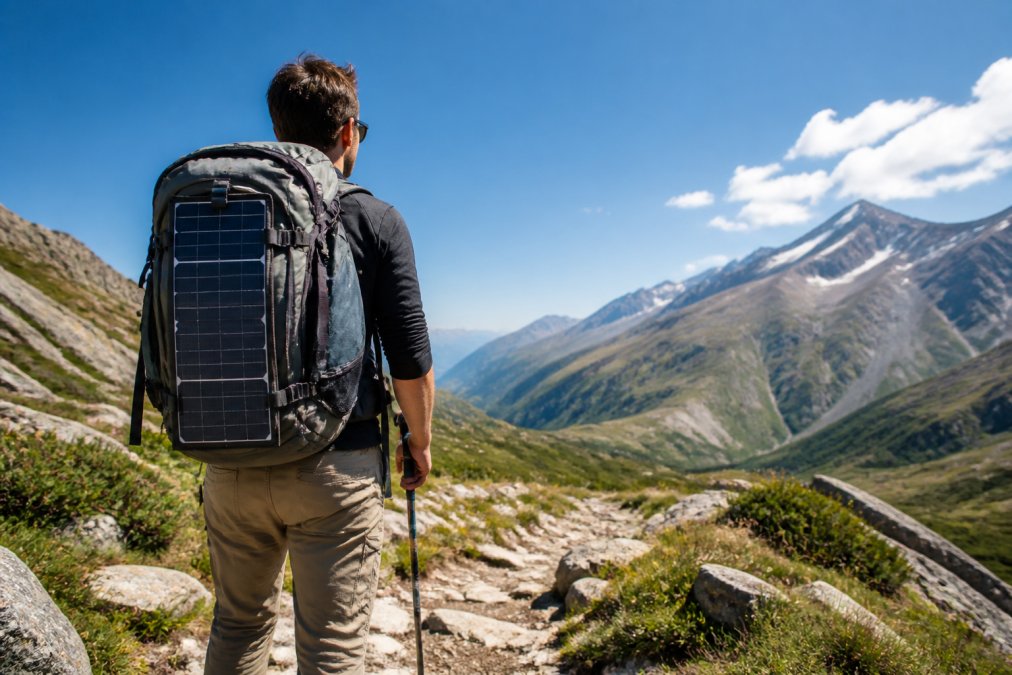
Conclusion
Portable solar chargers solve a real problem for outdoor enthusiasts: keeping devices powered in places where traditional electricity doesn't exist. The right charger depends on your trip duration, device count, weight tolerance, and climate.
Frequently Asked Questions
Do portable solar chargers actually work for remote hiking?
Yes, portable solar chargers work for remote hiking when conditions are right. A 20-30W panel in direct sunlight can charge a smartphone in 2-3 hours. Performance drops 40-60% on cloudy days and varies by panel efficiency (monocrystalline panels convert 20-23% of sunlight into usable power). For reliable off-grid power, pair a solar panel with a power bank to store energy for use when sunlight is limited.
What solar panel wattage requirements do I need for my devices?
A smartphone typically needs 5-10W for steady charging. Tablets and laptops require 15-30W or more. For remote activities, choose a panel rated at least 20W for phones and small devices, or 60W+ if charging tablets or power stations. Remember that rated wattage is measured under ideal lab conditions; real-world output is usually 30-40% lower due to angle, clouds, and heat.
Is a solar power bank better than a foldable solar panel for backpacking?
It depends on your trip length and weight tolerance. A foldable solar panel is lighter and cheaper but requires an external power bank to store energy. For multi-day trips, pair a lightweight foldable panel (under 300g) with a compact 10,000mAh power bank for the best balance.
What are the main limitations of using solar chargers in remote areas?
Weather is the biggest limitation. Clouds, rain, and shade reduce output by 40-80%. Solar chargers also have slow charging speeds compared to wall outlets, require proper angle positioning toward the sun, and depend on peak sun hours (typically 10am-2pm). For extended backcountry trips without guaranteed sunlight, a power bank backup is essential to avoid dead devices.